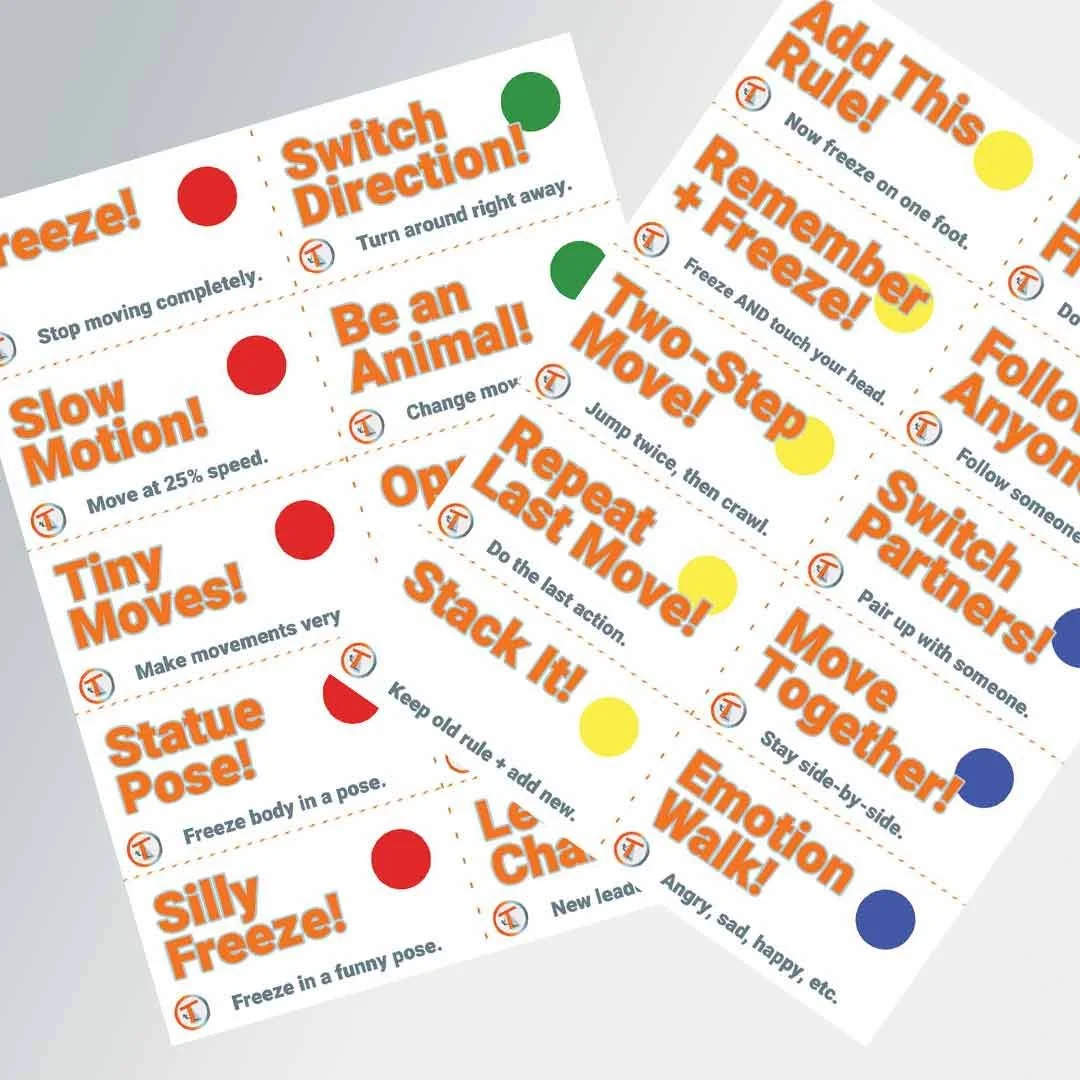
Flexible Thinking Game Cards
Download the printable game cards in our app!
Use this playful movement-based activity to strengthen the skills needed for learning, social success, and emotional regulation. Try the Flexible Thinking Freeze Game: a dynamic, brain-building game designed to support executive functioning in a developmentally appropriate way.
What Is Flexible Thinking?
Flexible thinking is the ability to:
Adjust when plans change
Follow new directions
Switch strategies when something isn’t working
Stay regulated when the unexpected happens
These skills are essential for classroom success, peer relationships, and everyday problem-solving.
How the Game Works
Children move to music using different actions like animal walks, hopping, or tiptoeing. When the music stops, they “freeze.” But that’s just the beginning.
Throughout the game, we introduce rule-change cards such as:
Switch direction
Move in slow motion
Do the opposite
Mirror a friend
Add a second instruction
As rules change, children practice adapting in real time. This strengthens cognitive flexibility, impulse control, working memory, and social awareness, all while having fun.
What Skills Are We Targeting?
This activity supports:
Executive functioning
Inhibitory control (pause before acting)
Working memory (remembering multi-step directions)
Motor planning
Frustration tolerance
Social referencing and turn-taking
We also build in short regulation breaks to help children notice when their brain feels “stuck” and practice strategies to reset.
Why Movement Matters
Many children learn best when their bodies are involved. Movement activates attention systems in the brain and makes abstract concepts, like flexibility and self-control, concrete and accessible.
By embedding executive function training into play, we create meaningful learning that sticks.
How Families Can Support This at Home
Parents can try simple variations:
Play music and practice freezing when it stops
Add “opposite” challenges (fast becomes slow, big becomes small)
Let your child be the rule caller
These small moments build big skills over time.